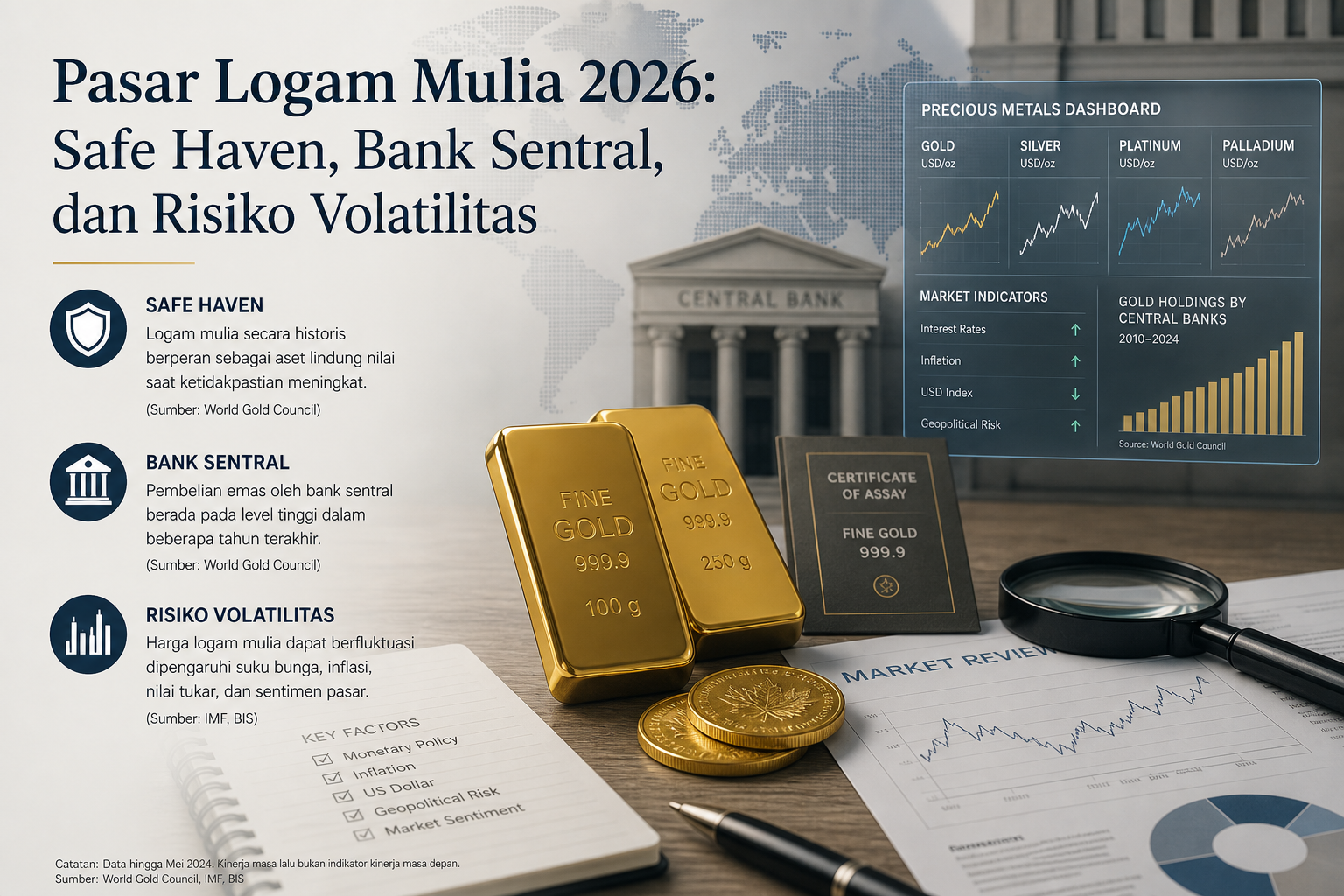
According to LBMA’s Alchemist summary for the 2026 Precious Metals Forecast Survey, published on March 1, 2026, the precious metals market enters 2026 with a mix of strong support and rising risk. LBMA highlights lower expected U.S. real rates, the potential for Federal Reserve easing, and central bank reserve diversification away from the U.S. dollar as factors that could support gold. But that picture does not stand alone: recent signals from CME Group and Trading Economics suggest that a stronger U.S. dollar, higher Treasury yields, and hotter U.S. inflation may still weigh on gold in the near term.
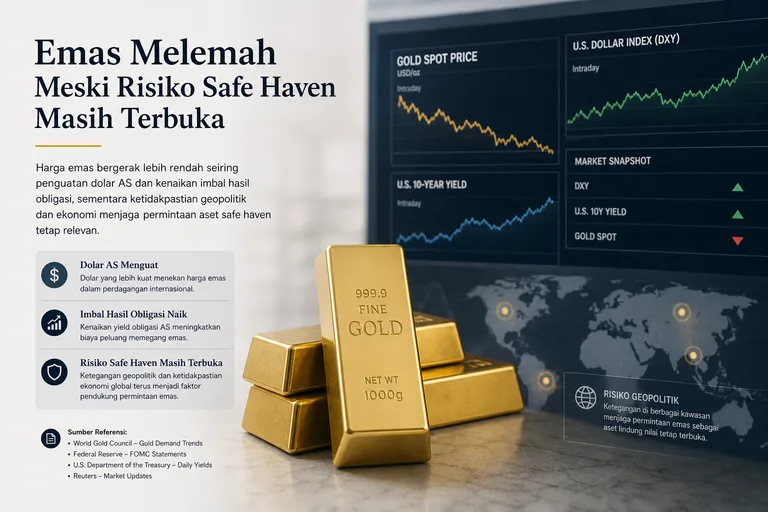
In other words, gold in 2026 is not moving on a single theme. On one side, it remains viewed as a safe-haven asset and a hedge against inflation and geopolitical uncertainty. On the other, it is highly sensitive to shifts in interest-rate expectations, especially because bullion does not pay regular income like bonds. When yields rise or the U.S. dollar strengthens, the opportunity cost of holding gold tends to increase.
This makes the market reading more balanced. Higher inflation can sound supportive for gold because it reinforces its role as a store of value. But inflation that is too strong can also delay rate cuts or even open the door to tighter policy expectations. In that kind of environment, safe-haven sentiment may remain intact, but pressure from the bond and currency markets still needs to be watched closely.
Gold sits between structural support and tactical pressure
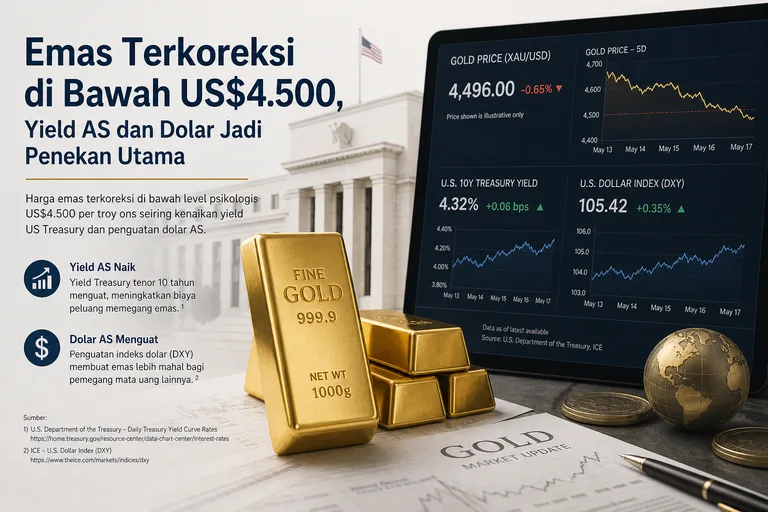
CME Group said in a metals market comment on May 18, 2026 that gold futures were trading slightly lower around 4,540, near a roughly one-and-a-half-month low. The early pressure was described as coming from a stronger U.S. dollar and higher yields. CME also flagged the next inflation release and the Federal Reserve minutes as important catalysts for the metals market.
This price context matters because it shows the market is not moving in one direction, even if the broader 2026 theme still supports precious metals. The level cited by CME is more than a technical number; it reflects how traders are reassessing positions as macro signals change. When the U.S. dollar strengthens, gold priced in dollars can become relatively more expensive for buyers using other currencies. When Treasury yields rise, some investors may prefer interest-bearing instruments over non-yielding assets like gold.
This article does not use local retail pricing or physical buy-sell spreads because that data was not included in the provided market material. For that reason, the price discussion is limited to the external context cited by CME and Trading Economics. Readers tracking physical bullion should still check official pricing sources for the relevant provider before drawing operational conclusions, including global benchmark prices, exchange rates, production costs, taxes, and dealer spreads.
From an editorial perspective, the most visible spread in this update is the narrative gap between medium-term support and short-term pressure. LBMA provides the structural case: lower real rates, possible Fed easing, and central bank reserve diversification. CME, by contrast, points to immediate pressure from the U.S. dollar and yields. That time-horizon difference leaves the market looking structurally firm but tactically vulnerable.
U.S. inflation is the most sensitive signal
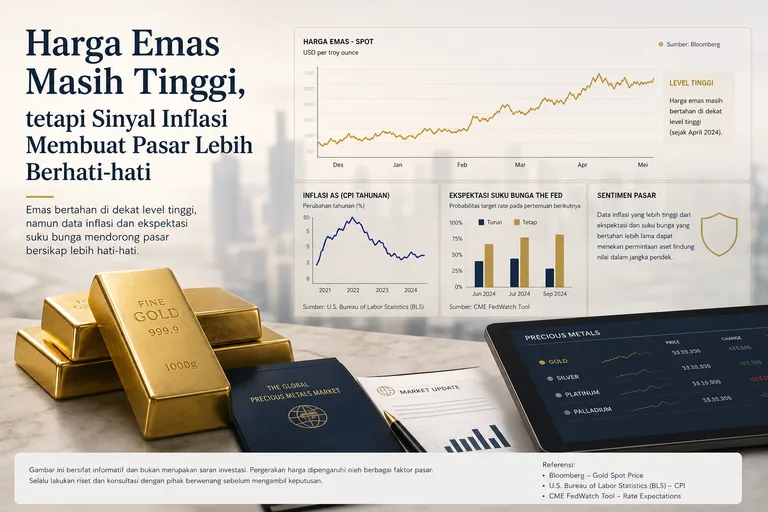
Trading Economics reported on May 12, 2026 that annual U.S. inflation rose to 3.8% in April 2026, from 3.3% in March. That was the highest reading since May 2023 and above the 3.7% forecast. Trading Economics also noted that energy inflation was the main driver, while core inflation rose to 2.8%.
This gives gold a mixed message. On one hand, higher inflation can strengthen demand for gold as a hedge. That logic often appears when investors look for a store of value as purchasing power comes under pressure. On the policy side, however, hotter inflation can make central banks more cautious about cutting rates.
Trading Economics also noted that gold came under pressure after the April U.S. CPI data came in above expectations. In that report, investors were said to expect the Fed to keep rates unchanged for the rest of the year, while markets started to price in the possibility of rate increases later on. This is the sensitive part for gold because the path of rates influences real yields, the U.S. dollar, and investor appetite for non-coupon assets.
Real yields are the bridge between inflation and gold prices. If inflation expectations rise faster than nominal yields, real yields can fall, and that environment is usually more supportive for gold. But if higher inflation pushes nominal yields and tighter policy expectations higher, real yields can remain elevated or rise further. In that second scenario, gold can face pressure even if the inflation narrative still looks supportive in theory.
Trading Economics, citing Federal Reserve data, also showed the U.S. 5-year breakeven inflation rate at 2.58% in May 2026. That measure is widely watched because it offers a market-based view of inflation expectations. For gold, a figure like this cannot be read in isolation; its impact depends on how nominal yields, Fed policy expectations, and the U.S. dollar move at the same time.
This is where 2026 volatility becomes understandable. If the next inflation readings remain high, the market may once again conclude that monetary easing will not arrive soon. If the data cools, the case for lower rates could return. Both paths can move gold, which is why traders are likely to wait for confirmation from official data and central bank communication.
LBMA places central banks as an important part of the broader 2026 picture. Reserve diversification away from the U.S. dollar is described as a factor that can support gold. This is a different kind of support from short-term speculative flows because it is tied to reserve management and institutional strategy. If central bank buying interest in gold remains in place, the market can have a structural cushion even when daily prices are volatile.
Still, central bank support does not mean gold prices move in a straight line higher. Gold is traded in a global market that reacts quickly to inflation data, yields, the U.S. dollar, and Fed expectations. Official demand can provide a backdrop, but it does not guarantee protection from near-term weakness. That is why reading gold in 2026 requires a distinction between slower-moving fundamental factors and daily catalysts that can drive volatility.
The safe-haven theme also remains relevant, but it is not always the dominant force every day. In a January 13, 2026 announcement tied to the launch of 100-ounce silver futures, CME Group said retail demand for metals exposure had increased amid geopolitical uncertainty and the energy transition. CME also reported that 2025 trading volume reached a record in smaller metals contracts, including Micro Gold and Micro Silver futures. This points to broader interest in precious metals, not only gold, even though each metal has different drivers.
Silver, for example, often sits between a monetary metal and an industrial metal. CME’s reference to the energy transition provides context that metals demand is not only about hedging. For this article, though, silver is better read as a signal of wider participation in the metals market. Gold remains the main focus because of its stronger link to the U.S. dollar, interest rates, inflation, and central bank reserves.
For bullion readers, the main lesson is to avoid a simple reading. Higher inflation does not automatically mean gold always rises. A stronger U.S. dollar does not automatically erase the safe-haven role. Central bank diversification can support long-term sentiment, but futures markets can still correct when yields rise. All of these factors are working at the same time, and their weight can shift from week to week.
Editorially, 2026 is better described as a market that has reasons to hold up, but also reasons to swing. LBMA gives the framework that lower real rates, the possibility of Fed easing, and reserve diversification by central banks can be key supports. CME and Trading Economics remind readers that the path to that scenario is not smooth, especially when U.S. inflation comes in hotter than expected and the market re-prices the policy outlook.
For now, the strongest signal to watch is the interaction between inflation, Treasury yields, and Fed expectations. The April 2026 U.S. CPI reading of 3.8% is an important marker because it changes how markets assess the monetary policy outlook. If inflation pressure stays elevated, gold may face headwinds from real yields and the U.S. dollar. If pressure eases, the easing narrative and safe-haven support may become more visible again.
The conclusion is straightforward: the 2026 precious metals market sits in a fragile balance between structural support and short-term macro pressure. Gold still has a role as a safe haven and diversification asset, especially in the context of central banks and global uncertainty. But price reading still needs discipline around official data, especially U.S. inflation, Treasury yields, the U.S. dollar, and Federal Reserve communication. The main references in this article are LBMA, CME Group, and Trading Economics; the figures and context above come from those sources, not from internal pricing assumptions or additional projections.
References
- CME Group (2026). Gold futures eased as stronger U.S. dollar and higher yields pressured prices. Bearish short-term for gold because higher yields and a stronger dollar raise the opportunity cost of holding non-yielding bullion, though upcoming inflation/Fed signals could revive volatility.
- Trading Economics (2026). U.S. inflation accelerated to 3.8% in April 2026, above forecasts. Mixed but material: hotter inflation can support gold as an inflation hedge, yet it may also delay Fed cuts or revive rate-hike risk, which can pressure bullion through higher real yields and a stronger dollar.
- Trading Economics (2026). Gold pressured by strong U.S. inflation data as rate expectations turn less supportive. Bearish near-term: stronger inflation reinforced higher-for-longer interest-rate expectations, reducing gold’s appeal despite its inflation-hedge role.
- LBMA (2026). LBMA analysts expect volatile 2026 precious-metals markets with gold supported by real rates, Fed easing, and central-bank diversification. Structurally bullish: lower real-rate expectations, reserve diversification, and geopolitical uncertainty can sustain investor demand for gold even during tactical pullbacks.
- Trading Economics (2026). U.S. 5-year breakeven inflation rate stood at 2.58% in May 2026. Supportive if breakevens rise faster than nominal yields, but bearish if inflation expectations push the Fed toward tighter policy and lift real yields.
- CME Group (2026). CME launched 100-ounce silver futures to meet record retail demand. Bullish for broader precious-metals participation: stronger retail access and demand for smaller contracts can deepen liquidity and support interest in silver and gold as alternative assets.