Lead market snapshot
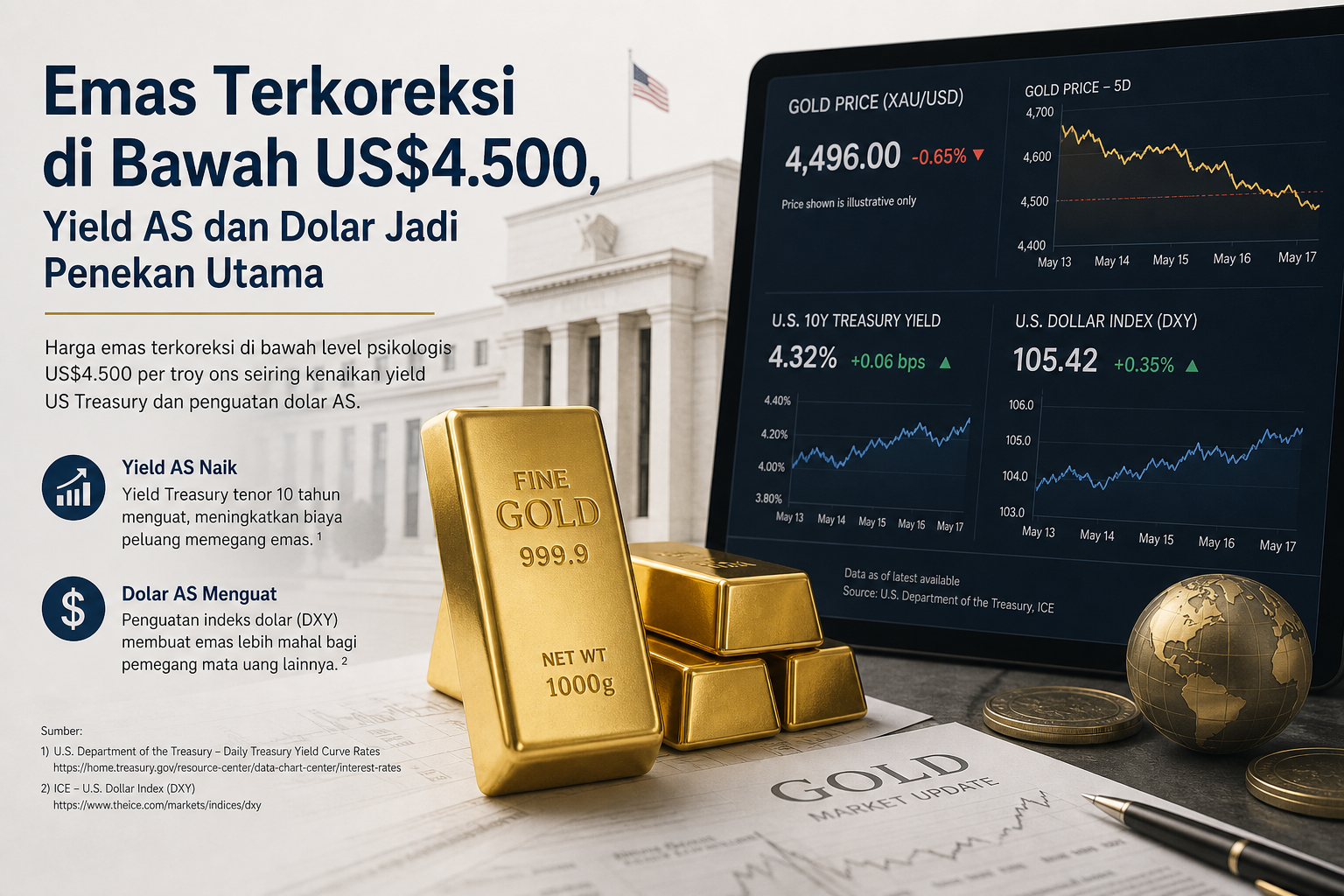
According to Kitco, New York spot gold was around $4,481.10 per troy ounce on May 19, 2026, down 1.85%. The move pushed gold back below the psychological $4,500 level. The same market update also noted that silver fell by more than 5%.
In bullion terms, this looks more like a correction under macro pressure than a standalone shift in trend.
Price context and spread
For readers in Indonesia, the Kitco figure should be read as a global spot price in U.S. dollars per troy ounce. It is not a domestic retail price, a buyback price, or a local bid-ask spread.
Because no local spread data was included in the source material, this article does not draw any conclusion about physical price differences in the domestic market.
Main movers or strongest signal
The strongest pressure in the Kitco report came from higher U.S. Treasury yields, a firmer U.S. dollar, and inflation concerns tied to oil. At the same time, the safe-haven narrative has not disappeared entirely, because risk-related demand tied to the Strait of Hormuz was still cited as one factor helping to limit sentiment damage.
That leaves gold caught between two forces: higher yields and a stronger dollar on one side, and hedging demand on the other.
U.S. yields are the clearest signal
Data from the Federal Reserve Bank of St. Louis via FRED showed the 10-year U.S. Treasury yield at 4.61% on May 18, 2026. That was up from 4.47% on May 14 and 4.59% on May 15.
This matters for gold because bullion does not pay a coupon or interest. Higher bond yields can therefore raise the opportunity cost of holding gold.
Put simply, when yields on income-bearing assets rise, some market participants may find bonds more attractive than assets that do not generate regular income. That does not automatically push gold lower, but it often acts as a short-term headwind, especially when a stronger dollar is also in play. In that sense, the FRED signal aligns with the pressure Kitco described in spot gold.
A stronger U.S. dollar is also relevant because global gold is priced in dollars. When the dollar rises, gold can become more expensive for buyers using other currencies. In that environment, near-term demand can soften even if other factors, such as geopolitical risk or inflation, continue to support bullion interest.
Inflation remains part of the backdrop
FRED also showed the 10-year breakeven inflation rate at 2.44% on May 20, 2026. This measures the market’s average inflation expectation over the next decade. The reading matters for gold because precious metals are often viewed as a hedge when inflation expectations remain above the 2% area.
Still, inflation does not affect gold in isolation. If inflation expectations rise but nominal yields rise faster, gold can remain under pressure through higher real yields or a higher perceived opportunity cost. For that reason, the 2.44% reading can be seen as neutral to mildly supportive, but not strong enough to offset pressure from yields and the dollar on its own.
This helps explain why gold can correct even when the inflation story is not fully resolved. Markets are not only asking whether inflation is high or low; they are also watching how the Federal Reserve may respond. When the market thinks rates may stay higher for longer, the dollar and yields usually become the variables that matter most.
Fed expectations and market pricing
CME FedWatch is one of the market’s reference tools for reading the probability of changes to the Fed’s target rate at upcoming FOMC meetings. It uses 30-day Fed Funds futures to track those expectations. For bullion, shifts in rate expectations can matter through two main channels: the U.S. dollar and Treasury yields.
If the market reads the Fed as more dovish, gold often gets support because pressure from yields and the dollar can ease. Conversely, expectations for higher rates for longer can weigh on gold by improving the appeal of income-bearing assets.
In the latest context, the clearest signals are the rise in the 10-year yield and the firmer dollar that Kitco identified as price pressure.
That said, this article does not infer the next Fed decision, because the source material does not provide a specific CME FedWatch probability. The careful conclusion is simply that rate expectations remain an important variable for bullion. As long as the market is still assessing the Fed path, gold can remain sensitive to yields, the dollar, and inflation data.
Editorial takeaway
Safe-haven demand has not vanished, but it is not the only story.
Kitco said demand linked to the Strait of Hormuz was still present even as gold corrected in the session referenced here. That suggests safe-haven support is not always enough to counter macro pressure in the short term. Gold can still attract hedging interest, but its price remains influenced by bond yields and dollar strength.
In bullion markets, safe-haven flows usually matter more when geopolitical or financial uncertainty rises sharply. When yields rise and the dollar strengthens at the same time, the effect can become more balanced or even tilt lower for prices. For that reason, safe-haven demand is better described as a factor limiting sentiment damage, not a guarantee that gold will keep rising.
CME Group also highlighted shifting asset correlations and physical fundamentals in its 2026 precious metals outlook. CME said central bank buying remains an important structural factor after large net purchases in 2024 and 2025. The same outlook also cited a World Gold Council survey showing that most central banks expect global gold reserves to increase.
This central-bank factor is different from day-to-day spot price moves. Central-bank demand is typically strategic and does not always move with short-term fluctuations. So even when a daily correction appears, the market can still watch whether official-sector support remains intact.
The LBMA Forecast Survey 2026 also placed uncertainty, investor flows, and central-bank demand among the key themes for gold. The survey said official-sector and investor flows remain relatively sticky, but LBMA also noted the risk that gold’s rally could weaken if central-bank buying and portfolio allocation slow. That is an important balance to keep in view: there are supportive factors, but also correction risk if demand flows fade.
From an editorial perspective, the data points here do not tell a one-way story. Spot gold did correct below $4,500 according to Kitco, and pressure from yields and the dollar is visible. But the 2.44% inflation expectation, safe-haven demand, and attention to central-bank buying mean the backdrop cannot be read as a simple decline.
For bullion readers, the healthier way to read this market is to separate short-term signals from structural factors. The short-term signal currently comes from the rise in the 10-year U.S. Treasury yield to 4.61% and the stronger dollar. Structural factors still being watched include central-bank demand, investor flows, and gold’s role as a hedge when inflation and uncertainty remain in focus.
The latest correction is also a reminder that a high price level does not eliminate volatility. Gold can trade defensively for a period, then soften again when the market refocuses on rates and the dollar. In this kind of setting, overly aggressive language is less useful than a careful reading of the data, which shows a tug of war between macro pressure and safe-haven support.
For now, the strongest signal in the source material is short-term pressure from U.S. yields and the dollar. Inflation, safe haven demand, and central-bank buying remain part of the backdrop and should be monitored, not used to dismiss correction risk. This article does not provide personal investment advice; it summarizes market context based on the public sources cited below.
Reference reminder
Primary references for this reading are Kitco for spot gold and silver on May 19, 2026; FRED / the St. Louis Fed for the 10-year U.S. Treasury yield and the 10-year breakeven inflation rate; CME Group for the FedWatch context and the 2026 precious metals outlook; and the LBMA Forecast Survey 2026 for analyst themes related to uncertainty, investor flows, and central-bank demand.
References
- Kitco (2026). Kitco spot market: emas turun di bawah US$4.500 saat yield AS dan USD menguat. Bearish jangka pendek karena yield dan USD yang lebih kuat meningkatkan opportunity cost emas, tetapi narasi safe haven masih memberi lantai psikologis bagi pasar bullion.
- Federal Reserve Bank of St. Louis (2026). Yield Treasury AS 10 tahun naik ke 4,61%. Cenderung menekan emas jangka pendek karena real/nominal yield yang lebih tinggi meningkatkan daya tarik aset berbunga dibanding bullion.
- Federal Reserve Bank of St. Louis (2026). Ekspektasi inflasi 10 tahun AS bertahan di 2,44%. Netral hingga suportif: ekspektasi inflasi yang tetap di atas target 2% dapat menjaga minat hedging, tetapi dampaknya bergantung pada apakah yield nominal naik lebih cepat daripada ekspektasi inflasi.
- CME Group (2026). CME: outlook precious metals 2026 menyoroti bank sentral dan perubahan korelasi emas-real yields. Suportif struktural karena permintaan bank sentral cenderung lebih strategis dan tidak selalu sensitif terhadap harga jangka pendek.
- LBMA (2026). LBMA Forecast Survey 2026: ketidakpastian, aliran investor, dan permintaan bank sentral tetap jadi tema emas. Bullish bersyarat: mendukung angle bahwa emas tetap diminati sebagai safe haven, tetapi editorial perlu menyoroti risiko koreksi jika arus bank sentral atau investor melemah.
- CME Group (2026). CME FedWatch menjadi acuan pasar untuk probabilitas perubahan suku bunga Fed. Dovish repricing biasanya bullish untuk emas, sedangkan ekspektasi higher-for-longer dapat menekan bullion melalui USD dan yield yang lebih kuat.