Market snapshot
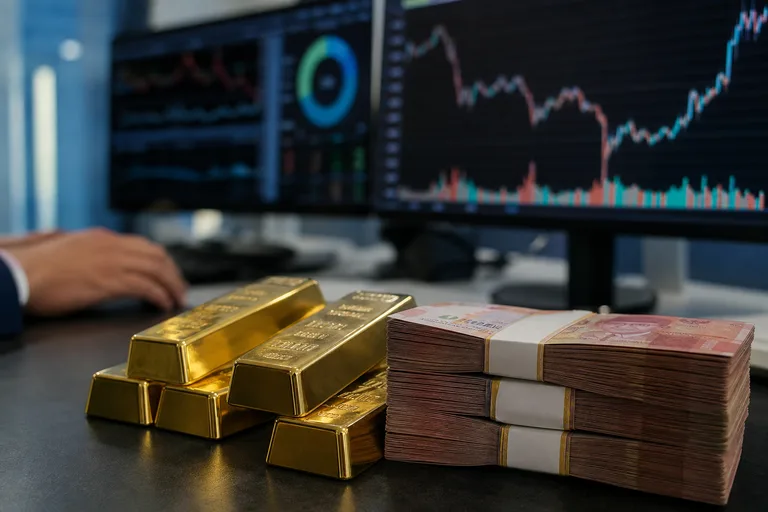
Gold is still being pulled in two directions. On one side, stronger U.S. inflation reinforces the case for gold as a store of value. On the other, the Federal Reserve has kept policy tight, which continues to limit appetite for non-yielding assets.
For Indonesian readers, the picture is not only global. Bank Indonesia’s policy stance and rupiah stability remain important because domestic gold prices are shaped by both the U.S.-dollar gold price and the exchange rate.
Price context and spread
According to the U.S. Bureau of Labor Statistics, U.S. consumer inflation rose 0.6% month on month in April 2026 and 3.8% year on year versus April 2025. Core CPI increased 0.4% month on month and 2.8% year on year, with energy and shelter among the main drivers.
This matters for bullion because higher inflation often strengthens gold’s appeal as a hedge. But the relationship is not one-way. If inflation keeps policy rates elevated for longer, gold can remain sensitive to the U.S. dollar and to yields on interest-bearing assets.
The Federal Reserve has kept the federal funds rate in the 3.50%–3.75% range, based on its April 29, 2026 implementation note. The interest rate on reserve balances was also kept at 3.65%, effective April 30, 2026. That leaves the opportunity cost of holding gold intact for now.
This article does not use retail price lists, buyback prices, or internal feed data. As a result, it does not assess a daily retail price level, a domestic bid-ask gap, or a specific local spread. The discussion here is limited to public macro signals and official market data.
Strongest signal: central banks remain a structural support
World Gold Council data adds an important demand-side signal. The WGC said total quarterly gold demand, including OTC, reached 1,231 tons in Q1 2026, up 2% year on year. In the same report, central bank buying was estimated at 244 tons, up 17% quarter on quarter, with Poland and Uzbekistan identified as major buyers.
That helps explain why gold should not be read only through retail demand or jewelry trends. Central banks remain a key structural source of demand, especially when gold is treated as a reserve asset and a long-term store of value.
The WGC also said in its Q1 2026 outlook that geopolitical factors are likely to remain a central driver of gold demand in 2026 and beyond. In its view, this supports net central bank buying, global gold ETF inflows, and accumulation in bars and coins. The message is consistent: gold is still being viewed through a risk-aware lens rather than a purely short-term trading lens.
Even so, strong demand does not mean the price will move in one direction only. WGC also places this environment in the context of high gold prices, which can change the mix of demand. A more cautious reading is to see central banks as a structural backstop, while day-to-day direction can still be shaped by inflation data, rate policy, the U.S. dollar, and market liquidity.
The London Bullion Market Association adds another layer of market depth. Its Daily Trade Reporting data shows London OTC gold trading value, based on a 12-week moving average for the period ended May 22, 2026, at US$1,071.96 billion. The figure includes spot, swaps or forwards, options, and lease loan deposits.
That depth matters because global gold pricing is not driven only by small physical transactions or local demand. The international bullion market spans spot trades, forward contracts, options, and lending mechanisms. At that scale, shifts in inflation expectations, rate policy, and global risk can move through multiple channels.
Editorial takeaway
For Indonesia, Bank Indonesia’s decision in its May 19–20, 2026 policy meeting adds a relevant local layer. BI raised the BI-Rate by 50 basis points to 5.25%. The Deposit Facility rate was raised to 4.25%, while the Lending Facility was lifted to 6.00%.
Bank Indonesia said the move was intended to strengthen rupiah stabilization amid global volatility and to keep inflation within the 2.5% ±1% target for 2026–2027. For domestic gold watchers, that matters because local prices are usually influenced by two main inputs: the global U.S.-dollar gold price and the rupiah exchange rate.
A more stable rupiah can reduce volatility in rupiah-denominated gold prices compared with a period of sharper currency swings. But stability in the exchange rate does not remove the influence of global gold pricing. When international markets react to U.S. inflation data, Fed policy, or central bank demand, domestic gold prices can still adjust through the global spot channel.
So there are two layers to keep separate. The first is global: U.S. inflation, Fed rates, central bank buying, geopolitical risk, and bullion market liquidity. The second is local: the rupiah and Bank Indonesia’s policy stance.
Because this source does not include retail prices or buy-sell spread data, it is not possible to say whether the domestic spread is widening or narrowing. What can be said safely is that rupiah stabilization remains an important variable in reading Indonesian gold prices, while any spread assessment still requires official bid and ask data at a specific point in time.
Reference reminder
The main references used in this article are the U.S. Bureau of Labor Statistics for April 2026 CPI data, the Federal Reserve for the federal funds target range, the World Gold Council for Q1 2026 gold demand and central bank buying, Bank Indonesia for its May 2026 BI-Rate decision, and the London Bullion Market Association for London OTC gold trading data.
This article is for market information only and is not personal investment advice.
References
- World Gold Council (2026). World Gold Council: permintaan emas Q1 2026 naik; bank sentral membeli 244 ton. Pembelian bank sentral yang tetap kuat mendukung narasi demand struktural emas, terutama sebagai aset cadangan dan penyimpan nilai saat volatilitas pasar serta risiko geopolitik meningkat.
- World Gold Council (2026). WGC Outlook Q1 2026: geopolitik tetap menjadi pendorong utama permintaan emas. Sinyal ini memperkuat angle safe haven: risiko geopolitik dan ketidakpastian kebijakan dapat menjaga minat investor pada emas fisik, ETF, dan bullion meski harga tinggi menekan permintaan perhiasan.
- U.S. Bureau of Labor Statistics (2026). Inflasi AS April 2026 naik 3,8% YoY; CPI bulanan +0,6%. Inflasi AS yang lebih tinggi dapat memperkuat narasi emas sebagai lindung nilai inflasi, tetapi juga bisa menunda ekspektasi pemangkasan suku bunga sehingga membatasi upside melalui biaya peluang yang lebih tinggi.
- Bank Indonesia (2026). Bank Indonesia menaikkan BI-Rate 50 bps menjadi 5,25% untuk stabilisasi rupiah. Kebijakan stabilisasi rupiah relevan untuk harga emas domestik karena emas lokal dipengaruhi harga spot global dalam USD dan nilai tukar rupiah; rupiah yang lebih stabil dapat meredam volatilitas harga emas dalam rupiah.
- Federal Reserve (2026). The Fed mempertahankan target Fed Funds Rate di 3,50%–3,75%. Suku bunga AS yang tetap relatif tinggi menjaga biaya peluang memegang emas non-yielding, namun stance yang ketat di tengah inflasi juga menambah sensitivitas emas terhadap data CPI, tenaga kerja, dan pergerakan USD.
- London Bullion Market Association (2026). LBMA: turnover emas OTC London 12-week average mencapai US$1.071,96 miliar. Likuiditas OTC London yang besar memberi konteks pasar fisik dan derivatif global; ini relevan untuk menjelaskan bahwa pergerakan harga emas ditopang pasar internasional yang dalam, bukan hanya permintaan ritel lokal.