1. Lead market snapshot
Energy risk is once again drawing attention in precious metals markets. According to the World Bank’s Commodity Markets Outlook released on April 28, 2026, tensions in the Middle East have weighed on global commodity markets, with energy prices projected to rise 24% in 2026. The report also highlights the risk of disruption in the Strait of Hormuz, a route used for roughly 35% of seaborne crude oil shipments, along with possible spillover effects on food, inflation, and debt costs.
For bullion readers, the key point is simple: gold does not move only because of gold-specific news. It also reacts to inflation expectations, interest-rate direction, the U.S. dollar, and demand for hedges. When energy becomes a new source of pressure, the path to gold is indirect, but still relevant.
2. Price context and spread
This article is educational and does not use retail pricing, store spread data, or internal feeds. The available price context comes from public sources. The World Gold Council said gold closed April 2026 at around US$4,611 per ounce and was broadly flat on a monthly basis.
No local spread data was provided, so the spread discussion is limited to general market context. In practice, retail gold prices can differ from global spot prices because of international pricing, exchange rates, taxes, production costs, and distributor margins.
For Indonesia, the same logic applies. Domestic gold prices are usually influenced by the global gold price and the rupiah’s value against the U.S. dollar.
3. Main movers or strongest signal
The energy-to-gold chain
Energy shocks matter because oil and other energy inputs are foundational to economic activity. When energy prices rise, transport costs can increase. Production costs may also climb, especially for sectors that rely on fuel, electricity, logistics, or supply chains with heavy shipping exposure.
From there, pressure can move into inflation. Goods that cost more to produce and ship may become more expensive for consumers. The World Bank explicitly links higher energy prices with food, inflation, and debt costs, showing that the issue is broader than the oil market alone.
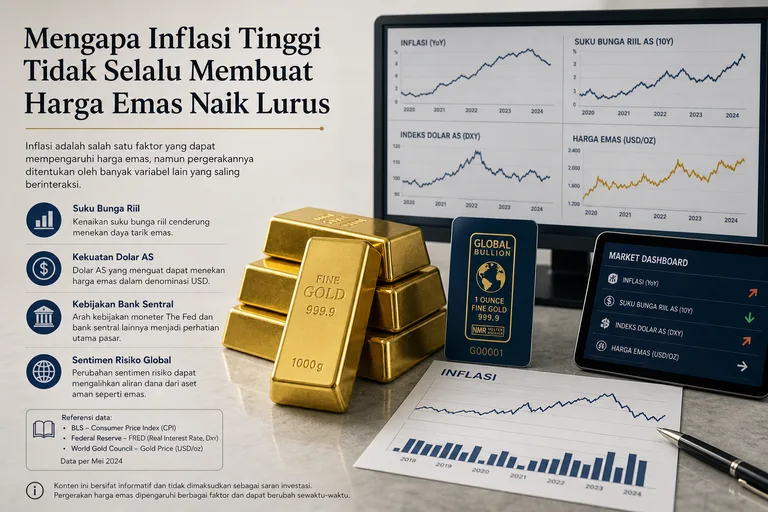
For gold, inflation is often read in two directions. On one hand, higher inflation can increase interest in assets seen as stores of value. On the other hand, inflation that stays too high can encourage central banks to keep rates elevated, which can weigh on gold because it does not pay interest.
That is why the energy-gold relationship is more complex than a simple “oil up, gold up” view. Markets usually ask whether energy pressure is stronger as an inflation and geopolitical signal, or stronger as a reason for central banks to keep rates high.
Gold price action: not just one number
The World Gold Council noted on May 7, 2026, that gold closed April 2026 at around US$4,611 per ounce and was flat for the month. That matters because it shows markets do not always react in one direction to geopolitical tension. In that period, the WGC said a return in risk appetite was one drag on prices, while a weaker U.S. dollar and ETF inflows helped support gold.
In other words, gold is caught in a balancing act. Middle East risk and the possibility of higher oil prices can support gold through safe-haven demand and inflation concerns. But if risk appetite improves again, or if expectations for higher interest rates strengthen, gold’s upside can be limited.
For Indonesian readers, exchange rates matter as well. The Bank of Indonesia said on May 20, 2026, that it raised the BI Rate by 50 basis points, from 4.75% to 5.25%, to strengthen rupiah stability against global shocks triggered by the war in the Middle East.
It also raised the Deposit Facility to 4.25% and the Lending Facility to 6.00%. Bank Indonesia described the move as pre-emptive, aimed at keeping inflation within the 2.5% ±1% target range in 2026 and 2027. That provides useful context: global risk can reach domestic markets through the exchange rate, imported inflation, and monetary policy expectations.
At the same time, the local inflation data available at the time remained contained. Bank Indonesia reported April 2026 CPI inflation at 0.13% month on month and 2.42% year on year, down from 3.48% year on year in March 2026. So while global energy pressure should be watched, it should not be treated as proof that domestic inflation is about to surge without new supporting data.
Why the Strait of Hormuz matters
The World Bank flagged the Strait of Hormuz because it is linked to around 35% of seaborne crude oil shipments. In energy markets, disruption to a major shipping route can affect risk perceptions even if the eventual price impact depends on duration, scale, and market response.
For gold, the key issue is not whether oil rises on a single day. The bigger question is whether markets begin to expect higher energy costs to last long enough to pressure inflation and growth. If that pressure persists, the term stagflation often enters the discussion: a setting where inflation is elevated while growth weakens.
The WGC also pointed to stagflation risk as a factor that can still support gold. In its commentary, it said markets had at times treated the Middle East shock as temporary, but higher oil prices, stagflation risk, and geopolitical uncertainty could remain catalysts for gold.
That signal should be read carefully. The key word is risk, not certainty. In bullion coverage, distinguishing between a risk factor and a final outcome is essential to avoid overstating the case.
Central bank signals: the Fed and Bank Indonesia stay cautious
The Federal Reserve, in its March 18, 2026 FOMC statement, kept the federal funds target range at 3.50% to 3.75%. The Fed said inflation remained somewhat elevated and that the implications of Middle East developments for the U.S. economy were still uncertain. It also said it would monitor incoming data, the outlook, and the balance of risks before making the next policy move.
For gold, that creates mixed signals. Geopolitical uncertainty and inflation can support hedging demand. But steady high rates can boost the appeal of interest-bearing assets and weigh on gold, especially if bond yields and the U.S. dollar strengthen.
The World Gold Council’s Gold Outlook 2026 carried a similar tone. Slower growth, falling rates, market volatility, and geoeconomic risk can support gold. But it also noted that rising inflation could force the Fed to keep rates elevated or even raise them in 2026, creating a tug of war between safe-haven demand and yield pressure.
In Indonesia, Bank Indonesia responded more directly to exchange-rate risk. The May 20, 2026 BI Rate increase to 5.25% was described as a step to stabilize the rupiah and mitigate the impact of global shocks. For domestic gold, the effect is mixed as well: higher rates can reduce the appeal of non-yielding assets, but rupiah stability concerns and geopolitical risk can still support hedging demand.
4. Editorial takeaway
The strongest signal for bullion readers in the available data is not geopolitics alone, but the inflation risk coming through energy. The World Bank gave a clear estimate: energy prices are projected to rise 24% in 2026 because of Middle East tensions and the risk of shipping disruption. That makes energy a macro risk, not just a daily news headline.
Still, that signal does not stand alone. The Fed remains cautious because U.S. inflation is still somewhat elevated and the impact of Middle East developments is uncertain. Bank Indonesia has also already reacted to global volatility, even though domestic inflation in April 2026 was still within target.
For gold, that means markets may stay alert without moving in only one direction. If energy pressure deepens inflation and geopolitical concern, gold can find support. If the same pressure reinforces expectations for higher rates and a stronger U.S. dollar, gold can face resistance.
That is why bullion editorial should avoid jumping to conclusions. An energy shock can become a gold catalyst, but it moves through several channels: oil, costs, inflation, rates, the dollar, and risk sentiment. Each channel can strengthen or weaken the final effect.
5. Reference reminder
The data available here does not prove that the world is entering a new energy crisis. What it does show, carefully, is that institutions such as the World Bank have already flagged energy risk as a major 2026 theme, especially around the Middle East and the Strait of Hormuz. The World Gold Council, meanwhile, sees gold still balancing safe-haven support against rate-related headwinds.
For bullion readers, the cleanest approach is to separate three layers of information. First, track energy and geopolitics, because they can affect inflation. Second, track central banks, because interest-rate responses shape the opportunity cost of holding gold. Third, track global gold prices and exchange rates, because those are the main drivers of domestic pricing.
This article is not personal investment advice. Its purpose is to help readers follow the cause-and-effect chain more calmly when energy, war, inflation, and gold are all in the same conversation. In a market like this, verified sources and grounded numbers matter more than fast conclusions.
Main references: World Bank, Commodity Markets Outlook, April 28, 2026; World Gold Council, Gold Market Commentary for April 2026, May 7, 2026; Federal Reserve, FOMC statement, March 18, 2026; Bank Indonesia, policy release on May 20, 2026, and April 2026 inflation release.
References
- World Bank (2026). World Bank: harga energi 2026 diproyeksi naik tajam akibat eskalasi Timur Tengah. Bullish untuk emas dan perak karena shock energi dapat menaikkan ekspektasi inflasi, memperbesar risiko stagflasi, dan mendorong permintaan safe haven. Namun, dampak bisa bercampur jika bank sentral menahan suku bunga lebih tinggi.
- World Gold Council (2026). World Gold Council: pasar emas melihat krisis Timur Tengah sebagai sementara, tetapi risiko stagflasi masih mendukung emas. Net bullish secara struktural, tetapi jangka pendek mixed: safe-haven dan inflasi mendukung emas, sementara risk-on dan prospek suku bunga lebih tinggi dapat menahan reli.
- Bank Indonesia (2026). Bank Indonesia naikkan BI-Rate 50 bps ke 5,25% untuk stabilisasi rupiah di tengah gejolak Timur Tengah. Mixed untuk emas domestik: kenaikan suku bunga bisa menekan appetite aset non-yielding, tetapi stabilisasi rupiah dan kekhawatiran geopolitik dapat menjaga permintaan lindung nilai.
- Federal Reserve (2026). Federal Reserve: inflasi AS masih agak tinggi dan dampak Timur Tengah terhadap ekonomi AS tidak pasti. Mixed: risiko Timur Tengah dan inflasi mendukung emas sebagai lindung nilai, tetapi sikap Fed yang hati-hati dan suku bunga yang tetap tinggi dapat memperkuat dolar/yield dan menjadi hambatan bagi emas.
- World Gold Council (2025). World Gold Council: skenario 2026 mendukung emas jika pertumbuhan melambat, risiko geopolitik tinggi, atau suku bunga turun. Bullish dalam skenario risk-off atau penurunan suku bunga, tetapi mixed jika shock energi mendorong inflasi dan memaksa bank sentral mempertahankan suku bunga tinggi.
- Bank Indonesia (2026). BI: inflasi Indonesia April 2026 turun ke 2,42% yoy dan masih dalam target. Netral hingga sedikit bearish untuk emas domestik karena inflasi lokal terkendali dapat mengurangi kebutuhan lindung nilai inflasi, tetapi tetap relevan jika imported inflation dari energi meningkat.