Lead market snapshot
Bank Indonesia was the key anchor for market reading this week. In an announcement on May 20, 2026, BI raised the BI Rate by 50 basis points to 5.25%, with the Deposit Facility at 4.25% and the Lending Facility at 6.00%. The central bank said the move was intended to strengthen rupiah stability amid global volatility, while keeping inflation within the 2.5% ±1% target for 2026–2027.
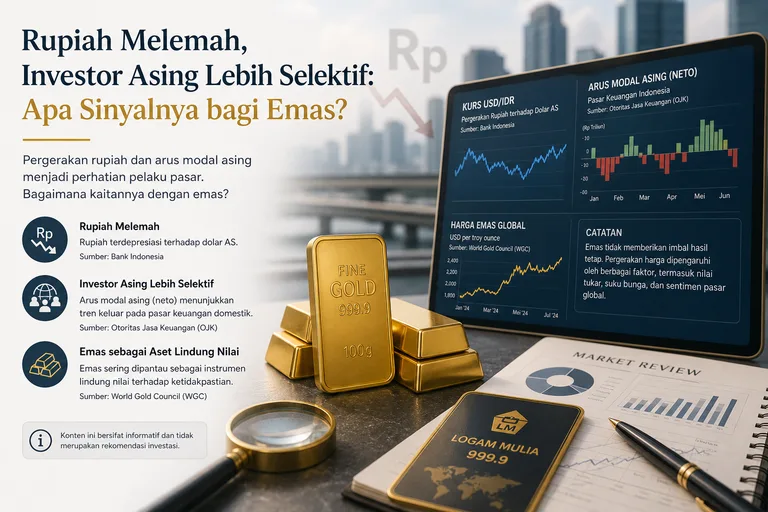
For Indonesia’s precious-metals market, this makes the gold price picture more complex than a simple “commodities up, gold up” reading. A weaker rupiah versus the U.S. dollar can lift gold prices in rupiah terms. However, a higher domestic interest rate also raises the opportunity cost of holding an asset like gold, which does not pay periodic income.
Price context and spread
BI also noted that on May 19, 2026, the rupiah stood at Rp17,700 per U.S. dollar, weakening 2.20% from the end of April. That matters because global gold is usually priced in U.S. dollars, while retail buyers in Indonesia see the final price in rupiah. When the exchange rate moves sharply, local prices can change even if global gold does not move in the same direction or by the same magnitude.
On May 23, 2026, based on data from each brand’s official website, the retail price for Antam 100 grams was recorded at Rp271,660,000 for the sell price and Rp257,700,000 for the buyback price. Compared with the previous sell price of Rp273,160,000, that was down Rp1,500,000. The spread between sell and buyback on this size was Rp13,960,000.
For Hartadinata Gift Series 100 grams, the sell price was Rp262,900,000 and the buyback price was Rp253,400,000 on the same date. The sell price fell Rp1,200,000 from Rp264,100,000, with a Rp9,500,000 spread.
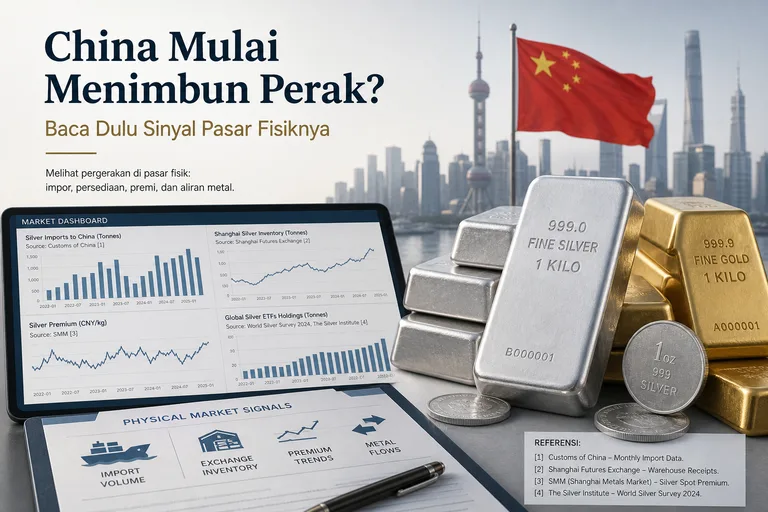
In silver, Silvergram 250 grams was listed at Rp16,001,000 for the sell price and Rp14,080,000 for the buyback price. The sell price was down Rp274,000 from Rp16,275,000, with a Rp1,921,000 spread.
These examples show why product comparison should not rely on the sell price alone. The buyback price and spread also matter, because they shape the effective cost seen by retail buyers.
Main movers or strongest signal
The strongest signal for Indonesian gold right now comes from the intersection of the rupiah and interest-rate policy. Rupiah weakness can make gold priced in local currency more expensive because the metal is benchmarked internationally in U.S. dollars. But a higher BI Rate can make interest-bearing instruments relatively more attractive than gold, so the effect is not one-directional.
That is why the current reading of gold fits an “inflation watch” framework. BI explicitly linked its latest policy move to rupiah stability and inflation targeting. When markets worry about inflation, energy, or global volatility, gold often returns to the radar as a hedge. But when rates rise, investors also weigh the opportunity cost of holding gold.
The Central Statistics Agency said April 2026 inflation was 0.13% month on month. That provides context that domestic price pressure in that release remained contained, but markets still need to watch external risks. Higher oil prices, a stronger U.S. dollar, or changes in global rate expectations can feed into local pricing through the exchange rate and sentiment.
Kitco News reported in March 2026 that gold and silver were supported by safe-haven demand amid the Iran war and rising risk aversion. The report also highlighted a stronger U.S. dollar, higher oil prices, and market attention on inflation and the Federal Reserve’s stance. For Indonesian readers, the key point is that gold can gain support from global uncertainty, but a strong dollar can also act as a brake or a source of volatility.
Reuters, via Kitco, also reported that Deutsche Bank raised its 2026 gold forecast to US$4,450 per ounce from US$4,000 per ounce. The reasons cited included stabilizing investment flows and persistent central-bank demand. Even so, the report also noted risk from expectations that Federal Reserve rate cuts may be smaller than previously assumed. This is an institutional forecast, not a price certainty.
Editorial takeaway
Indonesia’s commodity strength is visible in the BPS data, especially from CPO or vegetable oils, mineral fuels, iron and steel, and nickel. In external-balance terms, surpluses from these groups can help supply foreign exchange. If foreign-exchange inflows are stronger, pressure on the rupiah may be more contained than in a scenario without export support.
But the effect on gold is not automatic. A more stable rupiah can restrain local gold price gains, while global volatility can still keep demand moving. At the same time, stronger commodity income may support the purchasing power of parts of the domestic economy, even though the impact is not uniform across households.
Trading Economics reported that nickel futures climbed back above US$18,800 per ton after touching a near four-week low. The move was linked to reports of additional output cuts in Indonesia, including a lower ore-mining quota this year to support prices. That reinforces nickel’s role as one of the commodities global markets watch closely when assessing Indonesia.
According to Reuters, as cited by Investing.com, President Prabowo Subianto said the government would centralize exports of key commodities to increase state revenue and strengthen control over natural resources. Commodities mentioned included palm oil, coal, ferroalloys, and the potential pricing of nickel and gold. For the local bullion market, this kind of policy development should be monitored because it can affect foreign-exchange flows, supply, and domestic price formation.
Still, export policy should not be read as an immediate gold-price change without follow-up data. The impact depends on implementation, commodity coverage, market response, and how foreign-currency flows behave after the policy takes effect. For that reason, the safest reading is to treat it as a factor to watch, not a conclusion.
Reference reminder
For readers following gold prices, the current setup requires separating short-term signals from the broader macro backdrop. A daily decline in retail prices for some products does not automatically mean macro pressure has eased. Likewise, rupiah weakness does not guarantee that all local gold prices will rise on the same day, because international pricing, margins, spreads, and each issuer’s pricing policy also play a role.
Commodity strength does provide a positive story for Indonesia’s external accounts. CPO, mineral fuels, steel, and nickel are among the sources of non-oil and gas surplus cited in BPS data. But that support is better read as a macro buffer, not a guarantee that gold volatility will disappear.
In this environment, the most important signals to monitor are the rupiah, the BI Rate, inflation, the U.S. dollar, and energy-commodity prices. Gold sits at the center of the tension between hedging demand and rising opportunity cost. That is why the market narrative is neither fully bullish nor bearish; it is better described as mixed and highly dependent on the next data releases.
The editorial takeaway is simple: strong commodities can help Indonesia, especially through export sectors reflected in the non-oil and gas surplus. But for local gold prices, that support is offset by a pressured rupiah and higher interest rates. Readers should view bullion pricing as the result of multiple layers of factors, not just one commodity headline.
The main references for this article are Bank Indonesia, the Central Statistics Agency, Reuters via Investing.com, Kitco News, Reuters via Kitco, Trading Economics, and the official price websites of the bullion products mentioned. The price figures and macro data in this article follow the information available from those sources, without additional projections beyond the provided data.
References
- Bank Indonesia (2026). BI menaikkan BI-Rate 50 bps ke 5,25% untuk stabilisasi rupiah. Kenaikan suku bunga domestik dapat menaikkan opportunity cost memegang emas dalam rupiah, tetapi pelemahan rupiah terhadap USD biasanya menaikkan harga emas lokal dan memperkuat narasi lindung nilai.
- Badan Pusat Statistik (2026). BPS: surplus nonmigas Indonesia ditopang minyak nabati, bahan bakar mineral, baja, dan nikel. Surplus komoditas dapat membantu bantalan eksternal Indonesia dan rupiah; rupiah yang lebih stabil dapat menahan kenaikan emas lokal, tetapi pendapatan komoditas yang lebih kuat dapat mendukung daya beli investor domestik.
- Investing.com / Reuters (2026). Indonesia menyiapkan sentralisasi ekspor komoditas kunci. Jika kebijakan ekspor memasukkan emas atau memengaruhi arus valas komoditas, pasar bullion lokal perlu memantau implikasinya terhadap pasokan, harga domestik, dan stabilitas rupiah.
- Kitco News (2026). Kitco: emas dan perak mendapat dukungan safe-haven di tengah perang Iran. Menguatkan angle bahwa lonjakan komoditas energi/geopolitik dapat memicu inflasi dan risk aversion, dua faktor yang sering mendukung emas meski USD kuat bisa menjadi penahan.
- Kitco News / Reuters (2025). Deutsche Bank menaikkan proyeksi emas 2026 menjadi US$4.450/oz. Memberi konteks bullish struktural untuk emas: permintaan bank sentral dan investor dapat tetap menopang harga meski kebijakan suku bunga global menjadi sumber volatilitas.
- Trading Economics (2026). Nickel rebound karena pemangkasan output Indonesia. Kenaikan nikel mendukung narasi broad commodity upcycle; jika mendorong surplus ekspor, dampaknya dapat menguatkan rupiah, tetapi volatilitas komoditas juga bisa meningkatkan minat pada emas sebagai diversifier.